Guide
A Growth Company Guide to AI Automation (in plain English)
Four levels of AI automation in plain English. Find the first job worth automating and see which approach fits it, with three fillable templates.
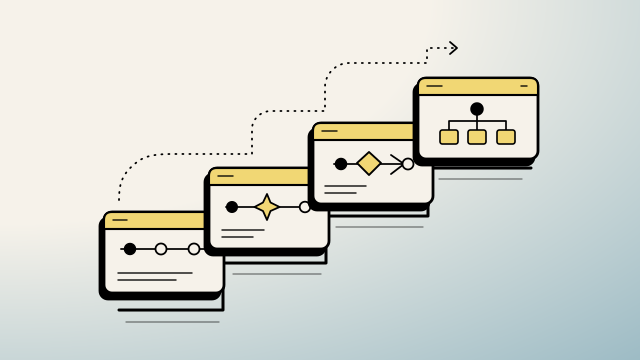
For leaders who need to decide where AI fits, who stays in control and what to build first. A 15-minute read, plus three templates to fill in.
Why now
Staff use AI to write faster, while quotes, orders and reports still move by hand. McKinsey's 2025 State of AI found 88% of organisations use AI regularly, but only 39% report an impact on profit. Companies getting real value are about three times as likely to have redesigned workflows around AI.
The automation ladder
Climb only as high as the work needs. Each level handles more variety and judgement, and needs more testing, oversight and budget.
- Workflow. Fixed steps and rules that run the same way each time. Best for predictable, high-volume admin.
- AI-powered workflow. Fixed steps, with AI reading, writing or sorting at a defined step. Best for emails, documents, forms and notes.
- AI agent. Works out the steps within a defined goal and limits. Best for varied requests across systems.
- Multi-agent system. A lead agent directs a team of specialists. Best for long jobs needing different skills.
Most teams start at level 02 and move suitable work to level 03 after proving accuracy.
What's inside
- Each level explained, with what it suits and what to watch out for
- One customer request handled four ways
- A four-question decision tree for choosing the right level
- Key terms in one sentence each, and four ways to connect your systems
- Where automation pays off, team by team
- Five steps before you build, and how to pick the right work
- Five ways AI projects stall, and eight questions to ask any AI partner
Three templates to fill in
- Work inventory. List the work one team repeats and sort it by weekly hours.
- Scorecard. Score three candidates on seven measures. 28 to 35 is a strong first workflow.
- Workflow map. Map one workflow as it runs today and use it to brief whoever builds it.
Bring your completed templates to a call and we'll help you choose the first workflow to trial.
Put it to work
Want this running inside your business?
Book a call. We will tell you which workflow to start with, what it costs to build and what it costs to run.